What Size Trash Bag Do I Need? Sizes Explained
You have probably stood in the trash bag aisle wondering why there are so many numbers on the box. Gallons, mils, dimensions, ‘tall kitchen,’ ‘contractor’ — none of it tells you what actually fits the can in your kitchen. Here is the simple version: gallons match the can, mils match the mess. This guide walks you through measuring your can, reading a gallons chart, picking the right thickness, and fixing common fit problems so you buy the right bag once.
Measure Your Trash Can Before You Shop
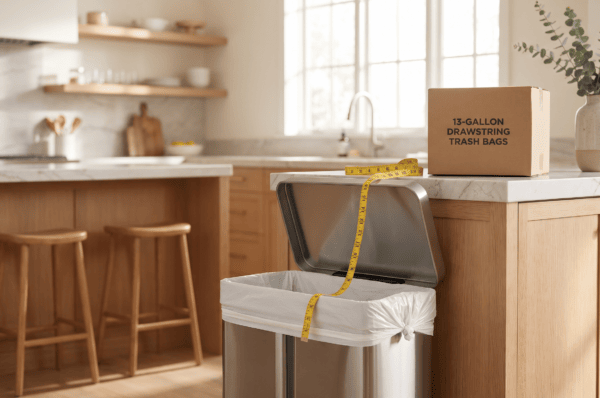
The fastest way to answer ‘what size trash bag do I need’ is to skip the guesswork and measure the can itself. You need a soft tape measure — or a piece of string and a ruler — and about two minutes.
Measure the Height
Measure from the inside bottom of the can to the rim, then add 4 to 6 inches. That extra material becomes the overhang you fold over the rim and the slack you need to tie the bag shut. If your can is 24 inches tall, you want a bag that is at least 28 to 30 inches deep before stretching.
Measure Around the Widest Point
Wrap the tape around the outside of the can at its widest point to get the circumference. A bag’s width should be at least half the can’s circumference, plus a few extra inches so it drops in without stretching. A stretched bag is a ripped bag — the side seams always give out first when the fit is too tight.
Quick formula: bag height = can height + 5 inches. Bag width = can circumference ÷ 2 + 3 inches.
Trash Bag Sizes Chart: Gallons by Room
Gallons describe volume — how much the bag holds, which should roughly match the size of your can. Here is the quick reference most households actually need:
| Can Location | Typical Can Size | Bag Size to Buy |
|---|---|---|
| Bathroom, dorm, office | 1.5–4 gallons | 2–4 gallon small bags |
| Under-sink or bedroom | 7–10 gallons | 7–10 gallon bags |
| Kitchen (standard tall can) | 12–16 gallons | 13 gallon tall kitchen bags |
| Large kitchen, garage, office | 20–30 gallons | 30 gallon large bags |
| Yard work, garage cleanout, moving | 33–45 gallons | 33–45 gallon heavy-duty bags |
| Rollout carts and drums | 50–96 gallons | 55–96 gallon liners |
If you are between sizes, size up. A slightly roomy bag still ties off neatly; a too-small bag tears at the seam or slides down into the can the moment something heavy lands in it.
What Are Mils? Trash Bag Thickness Explained
A mil is one one-thousandth of an inch, and it is the number that tells you whether a bag will survive what you put in it. The higher the mil, the thicker the plastic. Gallons are about fit; mils are about strength.
Which Mil Rating for Which Job
- 0.7–0.9 mil: light duty. Paper, tissues, dry packaging. Good for bathroom and office cans.
- 1.0–1.2 mil: everyday kitchen duty. Food scraps, dinner messes, normal household trash. This is the sweet spot for most homes — Melplas kitchen trash bags land right in this range, thick enough for food waste but still easy to tie off and lift.
- 1.5–2.0 mil: heavy duty. Wet leaves, garage cleanouts, yard clippings mixed with twigs.
- 2.5 mil and up: contractor grade. Renovation debris, sharp wood scraps, anything with corners.
One more wrinkle: stretchiness. Low-density bags stretch and shrug off punctures, which makes them better for mixed household waste full of bones, stems, and poking objects. High-density bags are rustly and thinner-feeling, better for paper-heavy offices and bathrooms. Most households only ever need the low-density 1.0–1.2 mil kitchen standard.
Getting the Right Can Fit: Slip, Sag, and Rips
Even the right gallon size can fit wrong once it is in the can. Here are the four most common problems and their fixes:
- Bag slips down into the can: choose a drawstring or flap-tie top that cinches under or over the rim, or go slightly wider with more overhang to fold down.
- Puddle of extra bag bunched at the bottom: the bag is too tall. Tie a knot in the bottom before lining the can, or drop down a size.
- Ripping when you lift it out: that is a mil problem, not a gallon problem. Go up one thickness level, not one size.
- Tight rectangular ‘slim’ cans: standard tall kitchen bags usually still fit — measure the widest point, not the corners, and compare it to the bag width.
Stock Up Before the Holiday Rush
Holiday hosting roughly doubles kitchen trash output, and the middle of a post-Thanksgiving cleanup is the worst possible moment to discover you are down to your last three bags. Run the math now: the average household goes through 3 to 4 kitchen bags a week, plus the occasional yard or garage bag — easily 200-plus bags a year. Black Friday is when multipack pricing per bag tends to drop lowest, so if you are going to buy a year’s supply in one order, that is the window. Melplas multipacks cover the common sizes — kitchen, large, and heavy-duty — so a single order can handle every can from the powder room to the garage before the season kicks off.
The Bottom Line
Match gallons to your can’s volume, mils to the weight and sharpness of what you toss, and always leave a few inches of overhang for tying. Measure once, buy the right multipack, and you will never stand in the aisle doing mental math again.